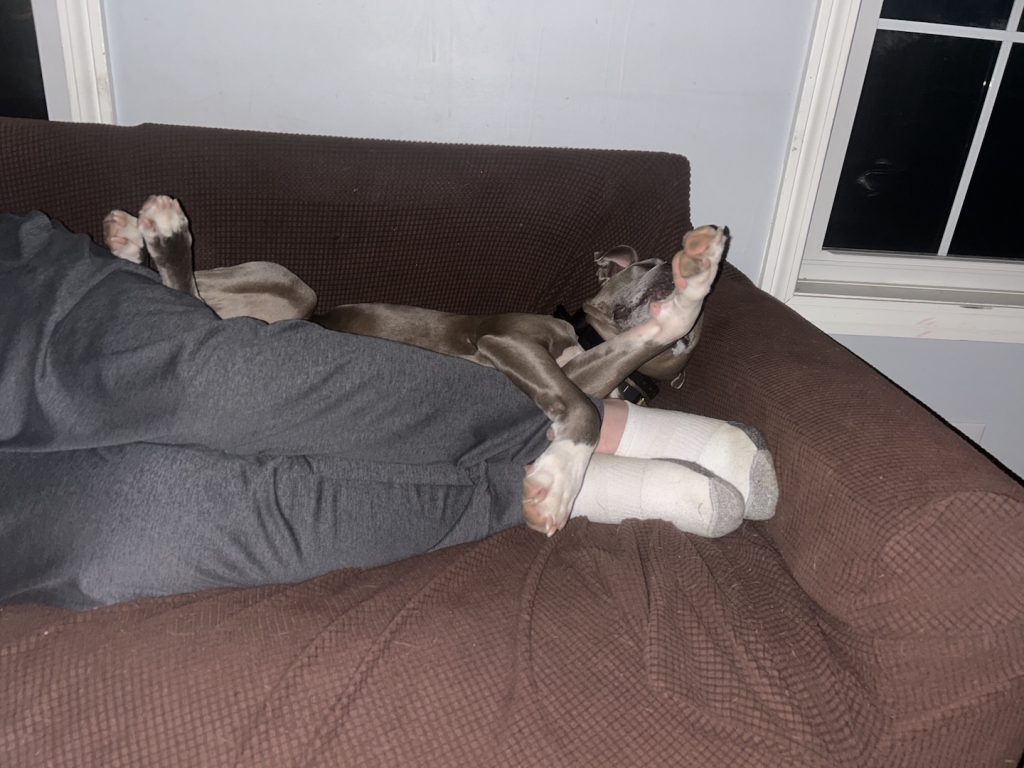
Earlier this week I had a dog in a session that was asked about a human baby on the way. Other animals have given me insight and tips to help prepare your pets for a new baby in the home.
This dog though shared something new with me! This dog wanted to hear the heartbeat of the new baby through a heartbeat monitor that has a sparker. This dog told me she would recognize the sound and rhythm of the baby’s heartbeat once the baby arrived, and know the baby is familiar and is family.
I am sharing this because I think it can help many pets.
Animals can hear the heart beat in a momma’s belly. They will recognize the rhythm and the sound, like they do with their own guardian. However, using a monitor with a speaker will amplify it for them, making it more familiar. Making it more likely to catch their attention.
By sharing the heartbeat with your pets every single day you are making that heart beat part of their every day life and routine. When the baby comes home, the heartbeat will be familiar, even if the baby is a bit scary or unknown. The familiarity of the heart beat will provide some comfort even though interactions should still be closely monitored for everyone’s safety. This includes for the safety and comfort of your baby and your pet.
Always remember, your animal is doing the best it can with what it has been taught.
Your animal is doing the best it can in the environment you have provided.
It’s not your animals fault if they haven’t been taught the way you want to be taught or haven’t been taught at all.
It’s not your animals fault if the environment they are in is causing them stress, anxiety, or fear.
Yes, a lot of them come without knowing much or knowing anything at al’ (baby animals, rescues, etc). When humans assume animals have already been taught, that creates conflict, frustration, confusion, and communication issues.
Sometimes what they are taught is fear and reactivity. When this is not acknowledged, misunderstandings happen, fear and reactivity escalate, and conflict increases.
But one thing I can promise you is every single animal is doing the very best it can do, every single day. There are no exceptions. Animals are too loving and too kind to live any other way. They are avoiders of conflict. They are people pleasers, even the ones you think are mean, stubborn, or combative. They aren’t. They are doing what they have been taught.
Think about how long it takes to learn a new language. That’s what it’s like for an animal when you are trying to teach them how to properly exist in your home, your barn, and in this human centered world.
If you think about it that way, I bet you will give them more time to learn before assuming what they know, or expecting them to know.
Teach them with patience, love, clarity, and most importantly TIME. They want to learn because they don’t want to get scolded. They don’t want to be confused. They don’t want to be afraid. They want to be loved and accepted. They want to be easy for you. They want you to approve of them and be proud of them. And most importantly, they want you to be happy.
If you are having miscommunications with your pet, please schedule a private reading to gain insight, clarity, and help the two of you understand each other better.
Nuisance Behaviors – Humans call them that, but these behaviors, to animals, are part of their every day life. These behaviors are part of their genetics. These behaviors are bred into them.
Scratching
Biting
Kicking
Bucking
Rearing
Jumping
Shredding
Animals use these behaviors for emotional balance, physical strengthening, cognitive exercising, and communication. Taking away the ability to participate in these core behaviors is mentally and physically damaging to our animals.
Although we must maintain safe relationships between animals and humans, we can do that while allowing them to communicate and while allowing them to be what they are, animals.
Providing safe and acceptable ways for animals to partake in these behaviors is necessary for health and wellness, emotionally, mentally, and physically.
Each behavior listed above is purposeful to animals. It is necessary. When we punish them for doing things they NEED, we are setting them up to fail. Instead, think of ways we can allow these behaviors in a way that is safe and acceptable.
We can provide them with space to run and play, or simply just to be alone.
We can provide them with appropriate places to scratch and appropriate items to chew on and shred.
We can provide them with the ability to say “no”, and listen as humans so behaviors do not escalate.
We can offer them privacy and peace while they are eating or chewing a bone.
We can offer them socialization with other animals where they can bite, tug, react, kick, etc… all in playful form without anyone getting hurt.
There is never an excuse to NOT allow these behaviors. There is always a reason to creatively allow these behaviors. And when you do, nuisance behaviors become non existent. We can teach them WHERE and how to use these behaviors, but we must never punish them for using behaviors that are genetically part of who they are.
If your animal’s behavior suddenly changes, take a moment to look at what’s happening in your environment — not just theirs.
Animals are incredibly sensitive to emotional and energetic shifts. They often respond to things like stress, routine changes, or unspoken tension before we even consciously recognize it ourselves.
What can look like anxiety, restlessness, or “acting out” is often their way of processing or reflecting something deeper.
Before correcting the behavior, try this:
Pause and ask yourself —
“What has changed recently, even in a subtle way?”
Then observe your pet without reacting. You may start to notice patterns that weren’t obvious before.
When animals feel understood, their behavior often begins to shift naturally.
If you’re unsure what your pet may be responding to, this is something I help uncover in animal communication sessions — identifying what they’re experiencing and what they’re trying to express.
Understanding is often the first step toward change
When animals are reactive (dogs, cats, horses, goats), correction is not going to yield the fastest results. Exposure is not going to lead the fastest results.
What do these animals need? They are reacting out of emotion.
When you are emotional and someone tells you to “calm down”, does that work? Nope.
If someone were to discipline you would that work? Nope, you’d get more angry.
If someone were to correct you, tell you youre wrong, tell you youre over reacting, would that work? Nope. You are reacting because you truly feel the emotions causing that reaction.
If youre reacting and someone else fires back with high emotion, will that work? Nope, youll both keep escalating.
If you were emotionally triggered or felt unsafe by something and your parent kept making you see that thing, would that work? Nope you would stay in a heightened emotional place and continue to feel unsafe. In fact, you may even feel betrayed.
Teaching emotional regulation (which is what reactivity is in animals) is not done through correction, discipline, exposure, or training. It’s taught over time by starting with limiting exposure to triggers.
You have to recondition and rewire the brain. The brain has been conditioned to react. “Neurons that fire together, wire together”. Most people have heard this. It applies to animals too.
It takes time for the brain to rewire. How does it rewire? By taking preventative measures to keep your pet calm and feeling safe. Love means acknowledging, to your animal, their fear, their anxiety, their level of discomfort is REAL to them. Aggression is also a form of all of those emotions.
By limiting exposure you allow your animals brain to literally rewire. You take them out of living in stress to living in calm and in peace. Once this happens you can start to gradually introduce triggers at a VERY far distance for VERY few seconds. Without ever crossing the threshold of allowing your pet to feel stressed.
This process takes SO long. But if are truly committed to it, you can take an animal that lives in stress to an animal that lives in safety and peace. Do you know how good that feels to them? It changes their entire life. And it will change yours too.
You two will develop the deepest bond and true trust.
And if you can’t commit to what it takes to help a reactive animal leave in peace, at least don’t get upset with them when they do react. I understand now everyone has the time for this. You can still love your pet for who they are, understand their emotions and fears are real to them, and most importantly, keep your emotions calm and neutral when they do react so they feel safe with you.
Play with your pets because it’s good for them and its good for YOU!
Playing with your pets increases the emotional bond the two of you share.
It keeps your pets mentally and physically active… and it does the same for you!! Double bonus!
This is especially important if you have adopted an animal later in their life and missed their early developmental and socialization years. The best news is… age doesn’t matter! Playing with your animal as an adult or senior will still develop the same trust and deep emotional bond that it doesn’t with a baby animal!
The most important part is finding play that is enjoyable and fun for your pet (taking into consideration any fears, anxieties, or trust issues). Animals without anything holding them back tend to like, hide & seek, peek a boo, chasing each other, etc… As long as you observe your pets behavior to make sure your pet feels safe this is fun for BOTH of you!
* Quick reminder, animals DO NOT like jokes. Jokes are not play. Jokes break trust *
You don’t have to play for long, even just a little bit every day will create benefits and rewards for both of you.
Be creative. Don’t just mindlessly through a ball or use a laser. Play WITH your pet. Engage WITH your pet. Put your phone away and be present. Let them play back with you!
Play is a beautiful, fun way to develop trust, deepen emotional bonds, and build new relationships with new pets.
Our responsibility is to respect and care for all living beings. This doesn’t just include our pets but all wild animals too.
This means –
* Gardening, trimming, cutting during times of year that do not disturb nests, babies, or hibernating animals.
* Creating safe spaces for wildlife around your home.
* Looking down to avoid stepping on insects and small animals when walking.
* Braking for animals crossing the roads.
* Observing wildlife, do not try to interact or get close.
* Helping domestic street animals (food, water, vet care).
* Avoid supporting venues, people, and events that use animals (especially wild animals) unethically entertainment.
* Capture insects and spiders in your home and put them outside.
* Buy cruelty free.
* Be a voice for the voiceless.
All animals on this planet need our help, our love, and our respect. It’s easy to love our own pets. It’s easy to do things for our own pets. It’s even easy to do things for domestic animals. But do you extend the same universal love, respect, and care to wildlife? Even the ones that are “unlovable” or labeled as “meaningless” (spiders, insects, worms, etc..).
It’s easier and quicker and a societal norm to view some animals as lesser value (bugs, spiders, etc), but what if it were you? These are still little souls, minding their own business, trying to survive. How we treat all animals, especially the ones others disregard, speaks loudly about the energy that surrounds us and the energy we put out into the world. It is the ultimate version of practicing “universal love”.
Animals develop and maintain friendships just like we do as humans. They need socialization beyond humans. These relationships help them learn and maintain boundaries and cues, and help with emotional support.
They develop love and strong bonds with others. Many talk to me about their friends. They make each other happy. They comfort each other. They offer emotional am support when one is injured or sick, old or dying. They groom each other. They play together. They become family. They take care of each other. When they see another in need emotionally or physically they feel empathy, like we do. These relationships run deeper than most humans realize.
Some animals are not friendly with others because of past trauma but the majority need relationships in some way with others, so they can thrive. There relationships with others is as important as their relationship with us and as important as our relationships are with other humans.
As humans, we can help encourage friendships. Sometimes humans aren’t enough. Sometimes they need other animals to truly thrive.
Now when their friends leave and never return due to rehoming, sale (horses), or death, expect to see the effects of a broken heart – or a lonely/confused heart. It is confirmation of the depth of the relationship
One of the best things you can do as a guardian is accept that your pet will have good days and bad days.
They will have days when they make mistakes.
They will have days when they are tired.
They will have days when they are a bit cranky or sad for reasons you may not know or understand.
They will have days when they just don’t feel like doing what you ask.
They are free willed sentient beings.
Accepting that your pet will not be their best every day, and that they will not be agreeable every day, is one of the best things you can do as a guardian to promote trust and connection.
Honor them where they are each and every day as the free willed sentient beings they are. Forcing them to do as they’re told every single day does not promote a relationship. Forcing them is a dictatorship. Some days they just won’t be their best and that’s absolutely ok. We arent our best every day either.
If you honor their emotions and feelings each day, they will do things you ask because they want to please you, because you have a relationship built on trust and love and acceptance.