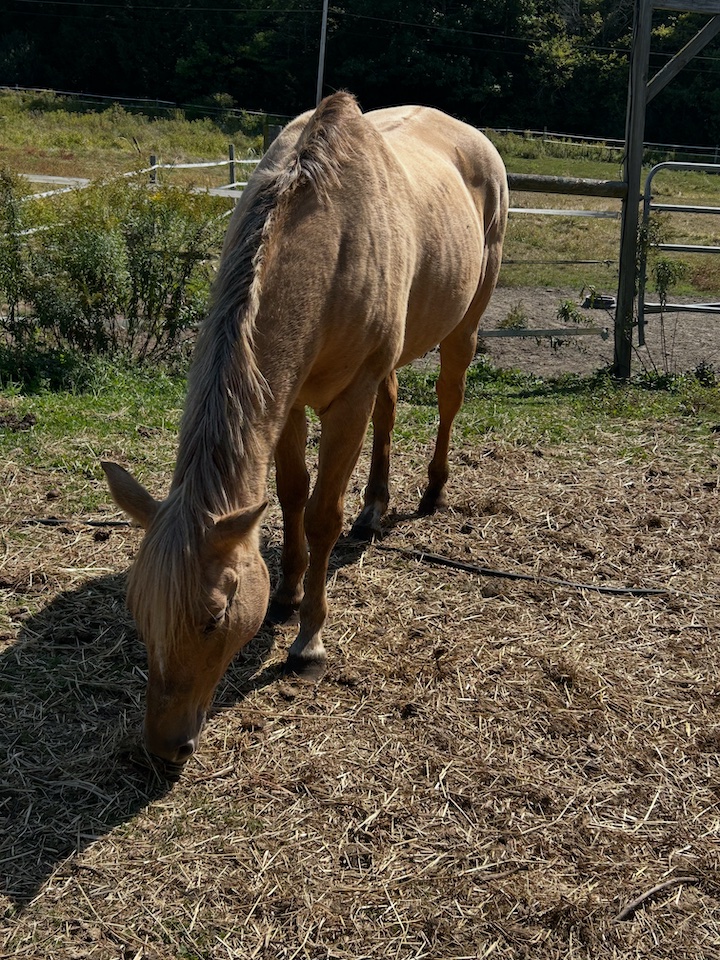
When you bring a new pet into your home or barn they will be living in a state of stress for the first week or more.
To them, its like being dropped into a foreign country without notice. A place where you don’t know anyone and no one speaks your language. A place where you don’t understand the language.
Their cortisol is going to be HIGH from this stress even when you have “saved” them. They are too stressed to know they’ve been saved.
They are going to be overwhelmed, make mistakes, and have accidents.
They are going to lack sleep, be confused, and try to protect themselves.
They are going to be living in survival mode.
If more people understood this and had the patience these animals deserve during this stressful time, more animals would stay in their homes (and not be returned). And more animals will settle in SOONER because instead of adding to their stress, your understanding and patience can minimize their stress.
Trying to be too friendly too quick, causes stress. Smothering them or introducing them to lots of new people, new animals or new places can cause stress.
Any animal moving to a new home (or barn) is going to feel ENORMOUS stress no matter how “good” the home is.
You won’t see the animal you truly have in your family for weeks. What they show you will be cortisol driven, survival driven.
Let them settle at their own pace without any expectations at all.
Allow them grace during their mistakes. Ignore the mistakes. I can promise you they are already worried. Knowing they “messed up” makes everything even harder for them.
Most importantly put yourself in their shoes, see the word from their perspective.
If you had no idea you were moving, but suddenly got dropped off in a foreign country where no one speaks your language and where you can’t understand the language. How would YOU feel?
Then imagine feeling the energy of those around you being impatient, knowing you made mistakes, but you don’t understand what those mistakes where. How would YOU feel?
Imagine trying to communicate and no one understanding. How would YOU feel?
Imagine living under expectations that you have never heard of? Not being taught with patience and kindness, just expected to know. How would YOU feel?
That’s how our animals feel.
But you can make their “move” safe and comfortable just by giving them time, patience and love. Releasing ALL expectations. And letting them show you when they are ready to open up, meet others, and go new places.
Two is always better than 1 when it comes to animals!
With very few exceptions, two animals are better than one because all of our domestic pets are meant to live with others of the same breed. Cats live in a colony. Dogs live in packs. Horses live in herds. Birds live in flocks. You get the idea.
Now of course due to trauma or lack of socialization some animals simply can not cohabitate with others. But, most of them cant. Issues arise when humans do not allow proper slow introductions.
Common mistakes made by humans when adding new animals to the family – even when your current pet(s) are very social.
Introductions done inside the home (introductions should be on neutral ground) If you have indoor cats, find a safe space in a garage or basement (somewhere your cat doesn’t often go)
Forcing pets to “like” everyone. Some pets won’t like another animal and thats ok! They don’t have to like them to cohabitate. They just won’t be best friends. They can learn to respectfully cohabitate with ANY animal if you give them the tools, guidance, and patience to do so. I have experienced this in my home when I added my dads dog to our family. (Read the story in comments)
Give up too quick. You don’t make a best friend in 30 minutes. Don’t expect your pet to make a best friend right away either. It takes MONTHS.
Blaming one animal if the introduction goes poorly. Yes, there are times it is one animal who instigated, BUT it’s not that animals fault. That animal may have felt unsafe, threatened, or unsure because of a mistake a human made with the introduction.
Setting pets up to fail by throwing them together too soon. Adding a new animal to a family means separation from each other when not supervised, for longer than humans want.
Not putting in the time or effort and expecting instant gratification. Humans love instant gratification. Many get frustrated, annoyed, or impatient when things aren’t instantly easy. Animals feel this energy and it escalates tension. If you don’t put in the time or effort you are setting them up to fail. All of them.
Not taking into consideration an animals past. Humans go through trauma and it can stay with them for their entire lives. Animals are the same. If they have gone through trauma do not expect them to leave that at the door when they enter your home. It comes in with them. And if you put them into a situation that triggers that trauma you are setting them up to fail.
Every single animal CAN succeed if humans take the time, put in the effort, and have the patience. When you bring a new baby home from the hospital your current kids may be jealous, mad, or pull “tantrums” because they don’t want to share attention. Animals are the same. They are the equivalent of a 2 year old. You wouldn’t bring your newborn back to the hospital. You would work with your kids over time to cohabitate. Fully expecting challenge and behavioral issues along the way. Animals are the same.
THE STORY OF ADDING BUCK TO OUR FAMILY
Here is my story of animals living together that don’t “like” each other.
When my dad died in April of 2024 I inherited his black lab, Buck. My pitbul, Titan, HATED buck. Buck was about 4 years old, Titan about 5. They met as young dogs but Titan never accepted Buck. He would growl, lunge, full on attack. We worked on pack walks, etc. but honestly never dedicated enough time to it because they didn’t live together so we just said nevermind.
I would go visit my dad and if Buck was outside and Titan was in my car he would go nuts at the window, agressive barking, trying to get out when I’d open the door, etc. Like most, I ignored it because I knew animals do not have to like everyone they meet, just like humans dont.
Once Titan even jumped out of my open sun roof to go full on attack Buck. Another time, Titan ran across a 10 acre field to go attack Buck. Titan went out of his way on many occasions to seek out Buck and fight. Buck never once retaliated. It was a one sided hate.
Clearly, I never thought I was going to inherit my dad’s dog. My dad died unexpectedly and rehoming Buck wasn’t an option. Animals are family. So I committed to making this work. I was forced. It took months. Months of me having them on leashed when in the house. Correcting and redirecting Titan when he would go after Buck.
Titan was tethered to me anytime Buck was in the main area of the house. Sometimes Buck would get a break in the bedroom and TItan could be untethered but I had to keep reminding Titan to not go to the door and try to get Buck, through the door.
Then it went from attacking intentions to hackles up. Then it went from hackles up to Titan being tense. Then it went from Titan being tense to Titan being off the tether, but my eye very on him. Because if Buck made one move that TItan didn’t like, the light switched and Titan went after him.
Titan was tethered to me anytime Buck was in the main area of the house. Sometimes Buck would get a break in the bedroom and TItan could be untethered but I had to keep reminding Titan to not go to the door and try to get Buck, through the door.
Then it went from attacking intentions to hackles up. Then it went from hackles up to Titan being tense. Then it went from Titan being tense to Titan being off the tether, but my eye very on him. Because if Buck made one move that TItan didn’t like, the light switched and Titan went after him.
Titan doesn’t listen to anyone else so I always had to be around when Buck was in the main area.
Now, they are fine! They cohabitate and they are ALL happy but they don’t like each other. Buck growls at Titan out of fear, Titan has learned to ignore it. Not many dogs could stand near a dog growling at them and not retaliate, but Titan has learned not to. Titan is a very domninant, alpha dog, but he has learned that he has to cohabitate with Buck.
We don’t leave them unservised alone and never will be able to, but when we are home, even my kids now (if I am not home) they can all be together and trusted without an extra eye on them. Titan and Buck just don’t lay down together or play together or hang out together. They all go outside together. When there is food around TItan and Buck can sit side by side and ignore each other : )
So it CAN be done. But it takes time, patience, consistency and commitment.
I have never seen a day hate another dog as much as Titan hated Buck, but he learned to cohabitate with force free redirection and consistency.
If you move, take them. You would take your child.
If your pet develops a behavioral issue, show them love, patience and understanding. Change what is happening. Don’t blame them or give up on them. Their behavior is their communication. They are trying to tell you something is wrong.
If you have a baby, keep your pet. It takes time, patience and understanding. Teach your pet how to be safe and respectful near your baby. Teach your child to be safe and respectful around your pet. The same expectation goes both ways.
If you adopt a pet, you are committed. It won’t be easy right away. It won’t be easy for a while. But be patient, make accommodations, make changes, make it EASY for your pet. It should be easy for them, hard for you. Not the opposite. But if you expect it to be easy for you, it will be hard for them. Give them TIME. So much time. These are the sacrifices we make to make them feel safe, loved, welcomed, and relaxed.
If something in your home or routine doesn’t work for your pet, change it. Don’t try to change the pet’s behavior or reaction.
Don’t give up on your pet. When it’s the hardest, that is when they need YOU most. They need your love, your patience, your understanding. They need you to help them. Not give up on them.
If your pet needs exercise, accommodate. If your pet needs your time, accommodate. If your pet needs to avoid a certain situation or person, accommodate. If your pet needs space, accommodate. This is how you build trust, love and a true relationship with them.
Animals are too often expected to adapt to our lives. But the trust is, they are the ones that are less capable so we need to adapt our lives to THEM. Just like we would with children. When you have a child your life will change. The same applies when you have animals. Expect your life to change.
Animals are willing to do anything and everything we ask if we take the time to teach them slowly and in a way they can understand. There is no purer form of love or loyalty on this planet.
Names carry energy. When naming or renaming your pet think about what type of energy you want your pet to have! Remember… you are the one that has to live with it….
Silly names will tend to yield a pet that is funny, goofy, maybe a bit mischievous.
A confident name will tend to yield a pet that is slightly dominant, a leader, bossy.
A cuddly name will yield a pet that is loving and gentle.
These names can help, but personalities are of course stronger than any name.
Sometimes. You should tell them. But be sure to tell them why they are in foster and they are worthy. You do not want them to feel abandoned or unwanted when they relocate again.
Animals feel when they are abandon, unwanted, and unloved. It hurts their self esteem. Animals are optimistic beings. They are excited about new possibilities when entering a new home. Many animals want to stay where they are. They ask to stay.
Some animals say they know it is a temporary spot for them and they are looking for someone else or a different environment.
Some animals want to stay but understand the foster process.
Some animals feels more abandonment, unworthiness, and shame when they know they have to leave again.
Many animals loves companionship of other animals and when they spend years together, they get attached. So the loss of one can greatly affect the other. Especially if they have spent their entire lives together.
Pets will grieve this loss, hard. And they may be lonely, sad, and get depressed.
Many humans want to bring in a younger friend or a puppy/kitten for the seniors companionship. At times, in single animal homes, humans want to bring the new baby in before the senior transitions so they are not a pet free home.
For the most part, animals are social beings. They want friends. They are happier with another animal in the home. There are always exceptions tho. Some animals have trauma and don’t want to be around other animals. And some of them just prefer solitude. Just like humans!
Things to keep in mind:
Relationships between the same animals will change over time and evolve like human relationships. Roles shift, aging and health change the dynamic, and changes in the home/lifestyle/etc affect the dynamic.
When there are relationship problems, most of the time, those can be worked out with a guardian’s help. (Again, exceptions are animals that have experienced trauma with other animals and will always need to be an only pet).
Our world is sadly filled with millions of unwanted and unloved animals. It is heartbreaking. However, I choose to see the brighter side. If I don’t the sadness is overwhelming. The brighter side is there are also hundreds of thousands of humans willing to open their homes to one of these pets.
Transitioning a new pet into your home is challenging, to say the least. This transition will test even the kindest, most loving animal guardian on some days. Especially in the beginning. Please know if it is challenging for you, it is doubly challenging for your new animal.